 India
India  UAE
UAE  Saudi
Saudi  Oman
Oman  Kuwait
  Bahrain
  Qatar
Qatar 

Arabic Perfume Notes Explained: Oud, Amber, Musk and Rose becomes much easier when the decision is connected to daily life rather than a rule copied from another climate. This guide explains classic Arabic perfume notes for people living in the UAE and GCC, where outdoor heat, humidity, moving between cars and buildings, and strong indoor air conditioning can all influence the experience. The aim is to recognise how oud, amber, musk and rose contribute different textures rather than treating them as one style. A thoughtful approach gives more useful results than chasing intensity or relying on the first spray.
Fragrance is personal, yet good evaluation can still be systematic. Notice where the scent will be worn, how close other people will be, how long the day may last, and whether the wearer wants quiet comfort or a more noticeable presence. The same perfume can feel different during daily wear, gifting and formal events. Context does not make one choice right and another wrong; it explains why application, timing and expectations need to change.
Start with the complete fragrance journey
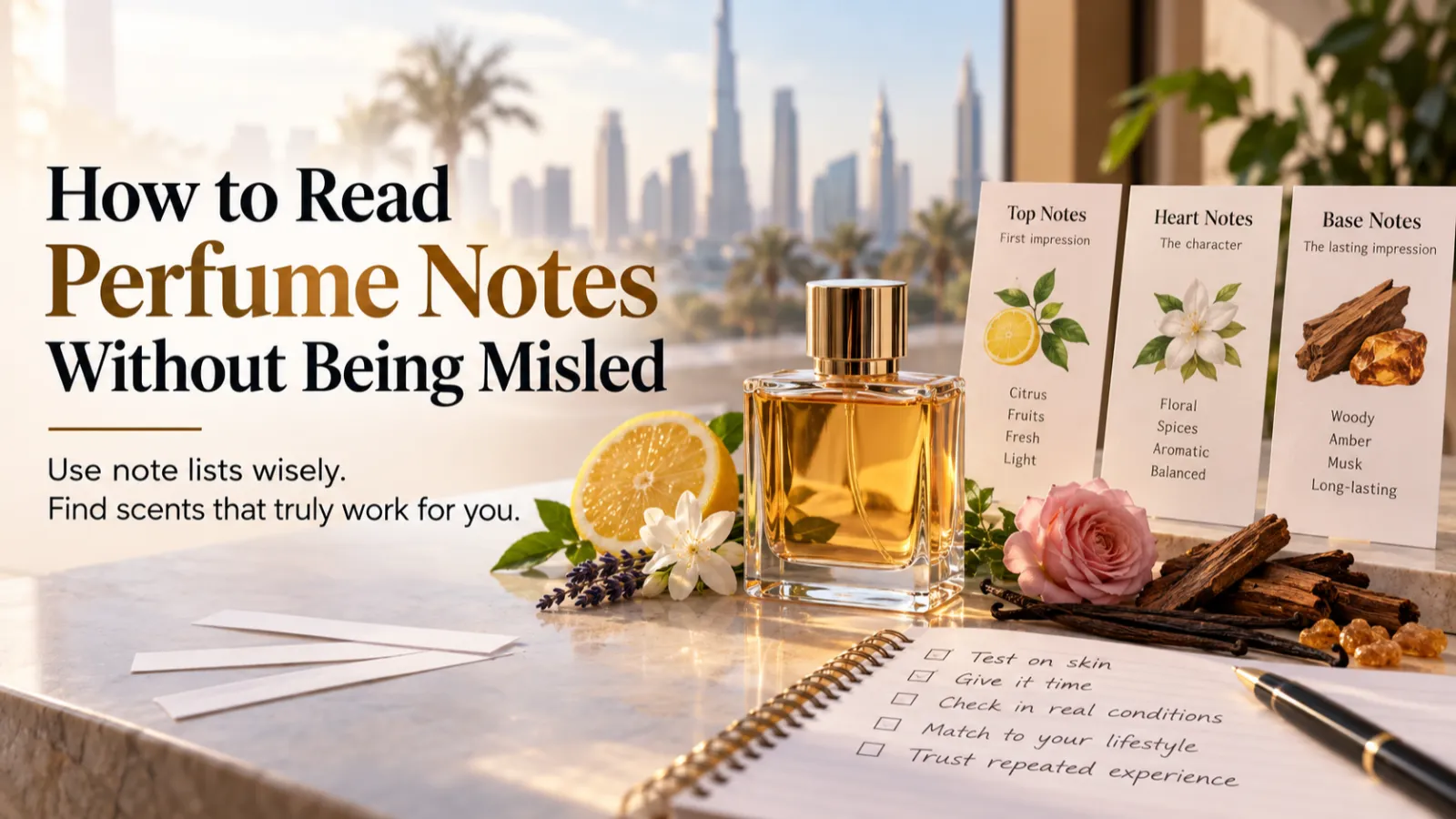
The opening is only the first part of a perfume. Bright materials may appear immediately because they evaporate quickly, followed by the heart and a slower base. Warm skin speeds diffusion, while cool indoor air can make development feel quieter. Give the fragrance time before deciding whether it suits the purpose. Check it after roughly thirty minutes, again after two or three hours, and once more near the end of the wearing period.
Use paper strips to create a shortlist, but use clean skin for the final test. Avoid scented lotion, deodorant or another perfume near the test area because overlapping aromas make comparison unreliable. Do not rub the sprayed spot. Rubbing does not lock fragrance into the skin and can make the opening harder to judge. Two serious candidates in one session are usually more informative than ten rushed sprays.
Account for UAE weather and indoor air
UAE days often include two opposite environments. Outdoors, heat encourages volatile materials to rise from the skin, which can make sweetness, spice, woods and amber feel larger. Indoors, air conditioning cools the skin and may reduce the scent cloud, although enclosed airflow can carry fragrance between desks and seats. Humidity, clothing, travel time and skin hydration add further variation. That is why an exact universal spray count is rarely useful.
Begin with a moderate application and observe before adding more. It is easy to refresh a quiet fragrance, but difficult to remove an overwhelming one before a meeting, meal or shared journey. When moving from outdoors into a close room, allow several minutes for your nose to settle. Ask a trusted person for feedback if you have worn the same scent for hours, because olfactory adaptation may make it seem weaker to you than it is to everyone else.
A practical three-step method
- learn each note family
- notice how notes support one another
- evaluate the final dry-down
These steps turn classic Arabic perfume notes into an repeatable process. Keep a brief note of the date, weather, number of sprays, placement and how the scent felt at each checkpoint. Plain descriptions such as clean, warm, dry, creamy, smoky, bright or close to skin are more useful than forcing yourself to identify every material. After several wears, patterns become clearer and decisions become less dependent on mood at the counter.
Match strength to people and place
Performance includes longevity, projection and sillage, but maximum performance is not automatically better. A close-wearing scent may be excellent for an office, prayer, a flight or dinner. A wider scent trail may suit an open venue or celebration when applied considerately. Quality is better judged through balance, a pleasing transition and a dry-down you still enjoy after the exciting opening has passed.
Respect shared space. Lifts, cars, meeting rooms and family seating place people near one another, sometimes for long periods. Apply fragrance before entering the space rather than spraying around others. If a refresh is needed, use a private ventilated area and make it lighter than the first application. People with asthma, migraines or scent sensitivity should never have to tolerate a heavy application for someone else’s enjoyment.
Avoid the most common mistake
A frequent error is selecting a fragrance from a single note name. It usually happens because the wearer responds to one moment instead of the complete experience. Pause, assess what is already present, and consider the next environment. Reviews and note lists can suggest what to test, but they cannot guarantee how a fragrance will behave on your skin, in your routine or around the people who share your day.
Storage also affects future tests. Keep perfume upright, tightly closed and away from windows, bathrooms and parked cars. A shaded cupboard with a steady indoor temperature is usually sufficient. Protect oils and scented materials from moisture and direct light. Good care reduces unnecessary changes and ensures that an impression recorded today can be compared fairly with another wear later.
Make a confident final decision
Ask three questions: Do I enjoy the fragrance after the opening has faded? Does its strength suit the actual places where I will use it? Would I choose it on an ordinary day, not only in an imagined special moment? A clear answer to these questions is more valuable than novelty. The best fragrance habit is one that feels natural, considerate and easy to repeat.
Arabic Perfume Notes Explained: Oud, Amber, Musk and Rose is ultimately about attention rather than complicated rules. Test slowly, account for climate, apply for the setting and trust repeated experience. This approach helps reduce mistaken purchases, prevents overspraying and builds a collection in which every scent has a real purpose. It also leaves room for enjoyment: perfume can be expressive and memorable while remaining comfortable for the wearer and everyone nearby.
Frequently asked questions
What does amber smell like in perfume?
Amber is usually an accord with warm, resinous, sweet or softly spiced qualities rather than one single ingredient.
Is musk always an animal-derived material?
Modern perfumery primarily uses safe synthetic musks that create clean, soft or warm effects.
Why are rose and oud often combined?
Rose adds lift and shape while oud supplies depth, creating a contrast that can feel rich and polished.
Can citrus appear in Arabic perfumes?
Certainly. Citrus often brightens a dense composition and makes the opening feel more accessible.
Which note should a beginner try first?
Begin with the texture you already enjoy—clean musk, warm amber, floral rose or woody oud—and test patiently.